
LinkedIn is Hiding You. The Data Proves It.
44% visibility drop, 95% of users frustrated. Why the "Great Exodus" to Substack isn't a trend—it's survival.

TL;DR:
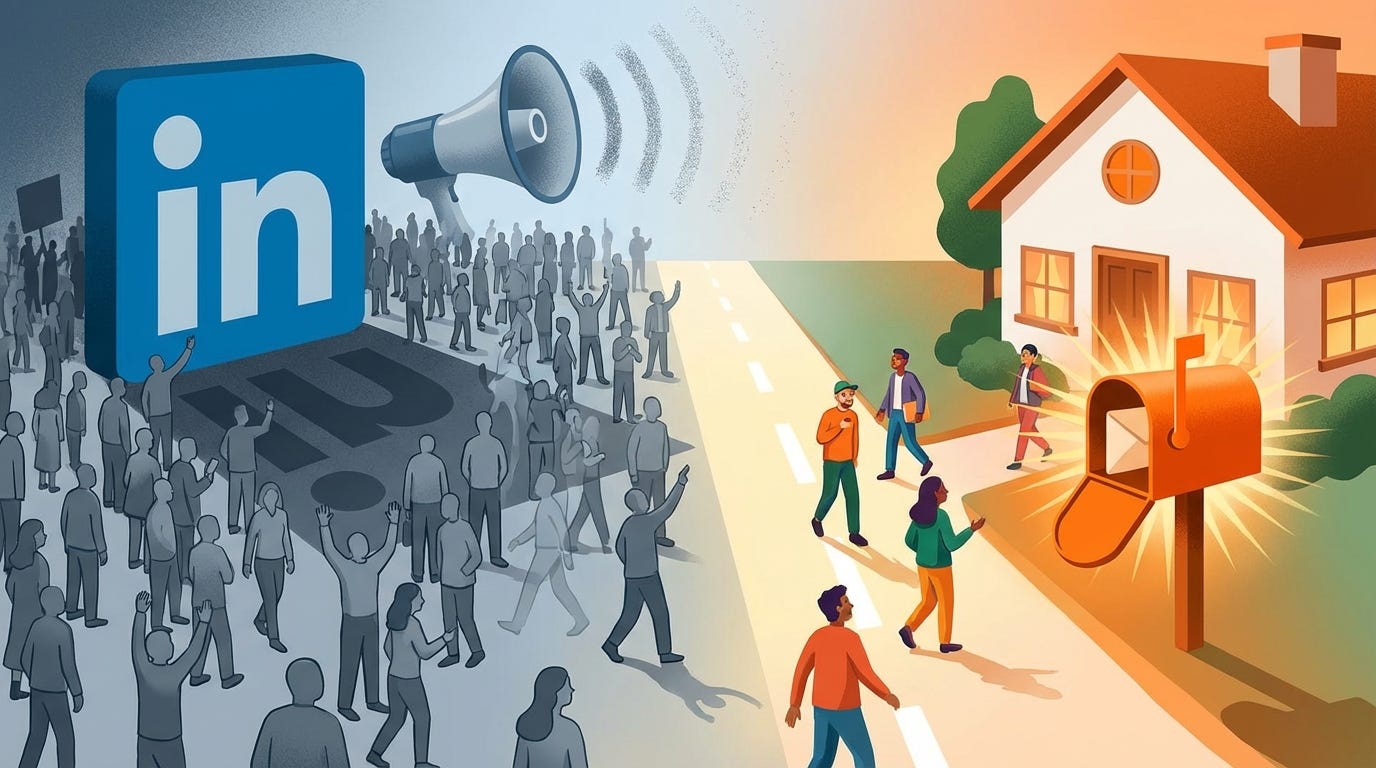
The collapse is real: Organic visibility on LinkedIn has dropped 44% since 2022, and 95% of users have noticed a decline. It’s not your imagination.
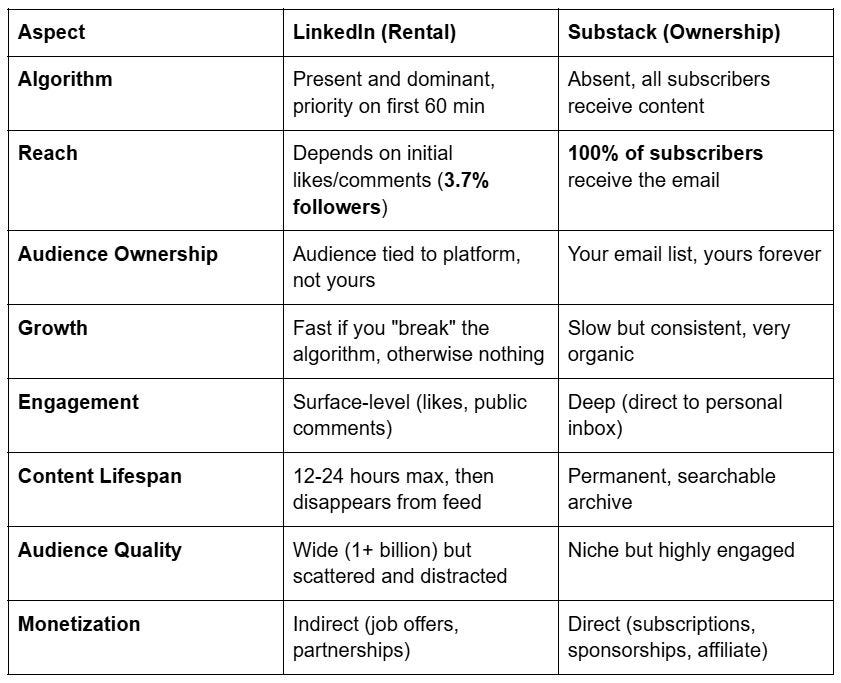
The “rental” model is over: On LinkedIn, you reach only 3.7% of your followers. On Substack, 100% of your subscribers receive your content. Always.
The winning strategy: LinkedIn to get discovered (20% of your time), Substack to build an asset you actually own and monetize (80% of your time).
January 2026. Has this happened to you recently?
You write a post packed with value, spend an hour on it, hit publish with that feeling of having created something genuinely useful… and all you hear is crickets. Maybe two years ago that same post would have gotten 5,000 views and brought you three qualified leads. Today? You struggle to reach 500 impressions.
If you’re feeling frustrated, I have good news and bad news.
The good news: it’s not your fault. You haven’t suddenly become less interesting, less competent, less relevant to your market.
The bad news: LinkedIn has changed the rules of the game, and this time the numbers are brutal. We’re in the middle of a silent but massive migration. Professionals, consultants, and experts are leaving LinkedIn’s crowded “plaza” to build their own “home” elsewhere.
I spent days analyzing the 2024-2025 data, and what emerges is unequivocal: the “Pay-to-Play” model has won. The rental era is ending. The ownership era has begun.
The visibility crisis: when numbers tell an uncomfortable story
Until 2023, LinkedIn was the organic reach goldmine for B2B professionals. Quality writing, consistency, and authentic value were rewarded. The system worked in your favor.
Today, the collected data paints an entirely different picture—what we might call systematic algorithmic suffocation.
The collapse has been vertical and progressive:
44% decrease from 2022 to today in overall organic visibility
50% year-over-year decline in creator visibility compared to the previous year
34% decrease in 2025 compared to 2024 in average reach
95% of LinkedIn users have noticed a decline in reach, engagement, or follower growth
But the most brutal data point is this: on average, only 3.7% of your followers see your posts. Got 5,000 followers? Congratulations, you’re reaching 185. Maybe.
Posts that once reached 1,000-2,000 impressions now stop at 500-1,000. Not because the content got worse. Because the system changed.
The “Golden Hour” of terror
LinkedIn’s current algorithm operates through a 4-stage system where the first time block—the so-called “Golden Hour”—has become a merciless judge.
Here’s how it works: if your post doesn’t receive significant engagement in the first 60 minutes after publishing, LinkedIn automatically cuts reach by 50%. And if you don’t maintain consistent engagement in the following hours, the post dies completely within 12-24 hours.
It doesn’t matter how deep your content is. It doesn’t matter how many years of experience you put into it. If it doesn’t “break through” in the first sixty minutes, you’re out.
The penalties nobody tells you about
LinkedIn is becoming a systematically hostile environment for those seeking depth and authenticity. Here’s the documented list of penalties:
External links: -60% reach (the most severe penalty)
Video posts: -36% reach, -23% engagement compared to 2023
Polls: -70% engagement (practically useless)
Text-only posts: -8% engagement
AI-generated comments: Automatically cut reach
Multiple posts per day: Penalized—LinkedIn recommends at least 12 hours apart
More than 5 hashtags: Flagged as spam
What still works? Document/Carousel posts (+47% engagement), Text + Image posts (+15% engagement), and LinkedIn’s native Newsletters (+45% engagement). But even these “winning” formats suffer from the systemic overall decline.
The concentration trap
There’s a new and particularly insidious phenomenon emerging.
You can receive 100+ likes and dozens of comments but have very few total impressions. How is this possible? It happens when a small restricted group—your engagement “pod,” the colleagues who always react—quickly interacts with your post. The algorithm sees that signal as not sufficiently diversified and doesn’t expand it to the broader network.
The post looks winning in engagement numbers but is actually trapped in a narrow bubble. It’s the illusion of success.
What those who are leaving are saying
Testimonials from the most followed creators are eloquent.
Justin Welsh, one of the most respected names in the business building world, wrote: “LinkedIn is going through growth pains right now that it can’t solve... 90% of comments are AI, too many cheatsheets, infographics, selfies, and posturing.” He created a Substack newsletter called, significantly, “Unsubscribe.”
Dan Koe noted: “Loving Substack so far. Mainly because there are serious people with incredible thoughts.” The difference in conversation quality is palpable.
Partha Bhattacharya, designer and consultant, explained his migration: “On LinkedIn, comments were scarce, likes or dislikes seemed elusive. On Substack I found ownership, direct connection, creative freedom, and real monetization.”
The result of all this? A feed increasingly full of AI comments, motivational selfies, clickbait, and superficial content. And serious people—those who want to build something lasting—are looking for alternatives.
Renting vs Owning: the paradigm shift
The fundamental problem isn’t the algorithm itself. It’s something more basic: it’s ownership.
Building your business exclusively on LinkedIn is like investing time and money to renovate a rented house. You can make it beautiful, functional, perfect for your needs. But the landlord—in this case Microsoft—can change the locks whenever they want, raise the rent (pushing you toward ads), or decide your type of tenant no longer interests them.
And the landlord is clearly pushing toward a Pay-to-Play model. Organic reach is declining in an organized, constant manner. LinkedIn silently promotes “Sponsored Posts” and ads. Even creators with hundreds of thousands of followers aren’t immune—organic reach drops for everyone.
Substack represents something radically different: the shift from renting to owning.
The real value of a subscriber
There’s a data point that completely changes the perspective: a newsletter subscriber is worth, in terms of engagement and conversion, 10 to 100 times a LinkedIn follower.
Why such a dramatic difference? Because the subscriber has overcome friction. They’ve actively decided to give you permission to enter their most private space—their personal inbox. They’re not passively enduring you while distractedly scrolling the feed in the bathroom or waiting for a meeting. They chose you.
On LinkedIn, your content is “noise” in an infinite feed. Followers have zero cognitive cost to follow you—one click and done. Perceived value is low.
On Substack, your content is “a conscious choice.” There’s friction to overcome (you have to subscribe, you’ll receive emails). And this friction increases perceived value for both you and the reader.
Growth numbers
Substack growth is objectively slower at the start: on average, it takes 9.2 months to reach 1,000 subscribers. With strategic support, this time drops to about 5.1 months (45% faster).
LinkedIn remains more effective for rapid initial acquisition. One creator reported getting 45 Substack subscribers in 2 months, but 145 from the first LinkedIn post thanks to their direct network.
But the point isn’t speed. It’s the quality and durability of what you build. LinkedIn growth is more spectacular but volatile—it depends entirely on the algorithm of the moment. Substack growth is slower but loyal—and most importantly, it’s yours.
Substack isn’t (just) a newsletter: it’s your new funnel
Here’s the number one mistake I see Italian professionals make: “I’m not opening a Substack because I don’t want to ask for 5 euros a month to read my emails.”
This is a myth that’s blocking thousands of consultants, coaches, and professionals from building a real asset.
The winning model for B2B professionals on Substack in 2026 is not the subscription. It’s using the platform as an authority engine to sell high-ticket services. The free newsletter becomes your most effective sales funnel.
The flow goes like this:
Free newsletter on [your topic of expertise]
↓
Audience: Business decision-makers interested in your field
↓
Soft CTA: “If your company wants [specific goal], let’s talk”
↓
Qualified lead generation for your services
↓
Consulting/training contracts
The 5 monetization strategies (beyond subscription)
1. Sponsorships—the most undervalued
Companies pay to access specific niches. And here’s the key: you don’t need a million subscribers. A newsletter with just 500-1,000 vertical subscribers—for example AI decision-makers, HR directors, startup founders—can generate $2,000-5,000/month in sponsorships.
Standard pricing ranges from $500 to $5,000+ per sponsorship, depending on size and engagement. Brands are interested in newsletters even when small, as long as the audience is qualified.
2. Affiliate Marketing
It’s the second sales driver after Instagram Stories. Recommend products and services you use and love, get a commission when someone buys through your link.
For a consultant in the tech/AI space, opportunities include SaaS tools (10-30% commissions), online courses (20-50% commissions), automation platforms, technical books. A single email with a well-placed affiliate link can generate $100-1,000+ if the audience is relevant.
3. Digital Products
Ebooks, courses, templates, toolkits sold directly to your list. No Substack fee on external sales. Typical newsletter conversion is 2-5%—with 1,000 subscribers, we’re talking 20-50 potential sales per launch.
Creators with just 500 subscribers have sold $5,000-10,000/year in digital products.
4. Paid Subscriptions (but as the last step)
Recommended pricing is $5-10/month for B2C niches, $15-50/month for B2B. But this is a tactic to implement after building the audience, not before.
Realistic scenario: 100 people paying $50/month = $5,000/month net (minus 10% Substack fee).
5. Consulting and Services (the real money)
This is the strategy professionals should consider primary. The newsletter is not the product—your consulting or training service is the product. The newsletter is the free marketing funnel.
With 50-100 niche subscribers who have high budgets, you can sell $50,000+ in consulting per year. The average deal for a specialized consultant ranges from $5,000 to $50,000+ per engagement.
The realistic scenario for a professional with 1,000 niche subscribers
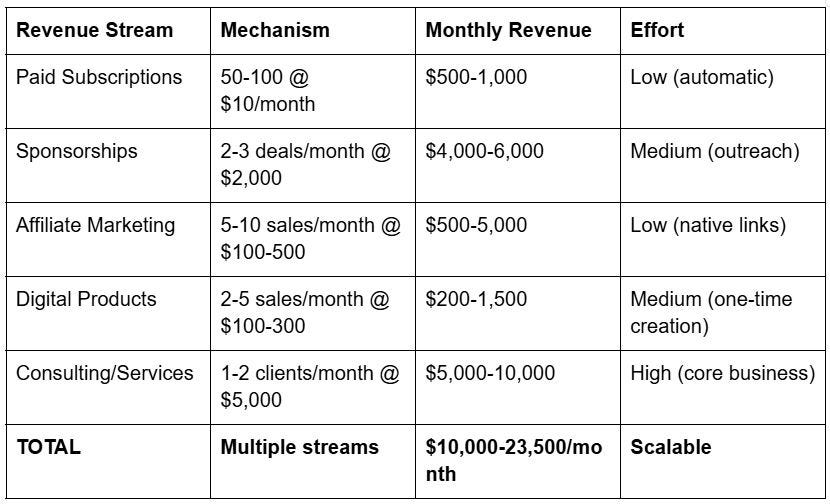
The key point: the focus isn’t on subscription revenue. It’s on the newsletter as a lead magnet and authority builder for your main business.
The hybrid strategy for 2026
Should we abandon LinkedIn? No. But we need to stop using it as a final destination.
The winning strategy today—the one adopted by the smartest creators—is using both channels for what they do best:
LinkedIn for DISCOVERY (Top of Funnel)—20% of time
The goal here is no longer building deep authority. It’s driving traffic out.
Use formats the algorithm still rewards: Carousels (+47% engagement), Text + Image (+15% engagement)
Stop writing deep essays that the algorithm buries
Every post must have one objective: soft CTA toward your newsletter
Leverage LinkedIn’s Newsletter feature to promote your Substack
An interesting data point: almost all Substack subscribers of the creators I analyzed initially came from LinkedIn. “Almost everyone who has gone to my Substack was through LinkedIn”—the discovery channel still works, if you use it for that purpose.
Substack for RELATIONSHIP (Bottom of Funnel)—80% of time
Here’s where you bring the deep content. The analyses that require 10 minutes of reading. The detailed case studies. The reflections that don’t “break through” the algorithm but build trust.
The winning content model for B2B:
60% Expertise + Trends: Trend analysis, personal insights, case studies, informed predictions
30% Actionable Insights: Practical guides, how-tos, frameworks, methodologies
10% Soft Sales: “If your company needs...”, service mentions, soft CTAs
On Substack, you convert attention into trust and trust into revenue.
Reality Check: Here I need to be brutally honest. Substack is not a magic wand. Initial growth is slow—we’re talking months, not weeks. You’ll need to write quality content consistently, without the immediate gratification of likes. And serious monetization comes after building a loyal audience, not before. But there’s a fundamental difference: on LinkedIn you’re building on someone else’s sand. On Substack you’re laying foundations that are yours. When LinkedIn changes its algorithm again—and it will—your Substack subscribers will still be there, on your list, directly reachable. That’s the only asset that matters in the long run.
The immediate action plan
If you’re a serious professional, here’s what to do this week:
1. Open your Substack. Not tomorrow, not next month. Today. Setup takes 30 minutes.
2. Plan 4 themed newsletters for next month. They don’t need to be literary masterpieces. They need to be useful for your target audience.
3. Read 3-5 successful Substacks in your field. Analyze what they do well, how they structure content, how they insert CTAs.
4. Change your LinkedIn strategy: Every post from now on must have a soft CTA toward Substack. Stop giving your best content to a platform that hides it.
5. Measure the right metrics: Not the absolute number of subscribers, but click-through rate (target: 3-5%), reply rate (target: 1-2%), conversion rate to client (target: 0.5-2%).
The long-term vision
Organic visibility on LinkedIn will continue to decline. It’s a structural trend, not a temporary anomaly. Microsoft has every interest in pushing toward the ads model—that’s how mature platforms monetize.
Your email list, on the other hand, is yours forever. No algorithm can decide to hide you. No policy change can zero out years of work.
Optimal time investment?
30 minutes per day on LinkedIn—1-2 posts per week, strategic engagement
3-4 hours per week on Substack—1-2 quality newsletters
With this model, $10,000-20,000/month in 9-12 months is a realistic scenario for a professional with solid expertise.
Don’t wait for the algorithm to silence you completely. Start packing today.
What about you? Have you noticed the performance drop on LinkedIn over the past year? Are you already building your “lifeboat” elsewhere? Or do you think the system will fix itself?
Let’s talk in the comments—the conversation quality is different here.
I'm actually going to implement the strategy. :D
Such a good read too.
Great write-up & welcome to Substack! 😊
Found the same thing deciding on my media strategy for 2026. Most of the big platforms are hitting their peak rent-extraction phase
If LinkedIn continues pushing this direction, we could we'll see a Clubhouse type platform for B2B briefly surge this year
https://open.substack.com/pub/metacircuits/p/media-strategy-for-2026-a-practical