
The Death of the "Coder" and the Birth of the Architect: My 2025 with AI
Thirty years ago, I learned to code alone in a dark room. Today, I have an army of digital agents working for me. Here is what happened this year.

When I started programming thirty years ago, the Internet was a quiet place. If your code didn’t work, you were on your own. You sat in front of a CRT monitor, surrounded by a stack of paper manuals as thick as bricks, hunting for errors line by line. “Fending for yourself” wasn’t a choice; it was the only pedagogy available.
Then came Web 2.0, Stack Overflow, and online communities. Suddenly, you weren’t alone anymore, but the work remained fundamentally manual: copy, paste, adapt, debug. For twenty years, this was my life: days (and nights) spent translating human logic into machine syntax.
When ChatGPT was released three years ago, I thought, “Fantastic, a junior assistant that never sleeps.” It helped me write functions and generate boilerplate, but 90% of the heavy lifting was still on my shoulders. It was useful, but not revolutionary.
Then came 2025.
If you are reading this at the end of this year, you know what I’m talking about. This year wasn’t an evolution; it was a dam breaking.

The Quantum Leap of 2025: From 30% to 90%
At the start of 2025, AI wrote about 30% of my code. Today, as I write this, we have reached 80-90%.
What changed? The technical answer is Reinforcement Learning with Verifiable Rewards (RLVR). Models no longer just predict the next token; they “reason,” attempt different approaches, verify the result, and correct themselves before even showing you the output.
My job is no longer writing code. My job has become Orchestration.
I no longer spend hours moving data from a database to a frontend view. Today, I write a prompt, define the architecture, and let agentic tools (like the new versions of Windsurf or Copilot’s agent modes) do the dirty work. They know how to use the terminal, they know how to read documentation, and they know how to fix their own mistakes.
As I analyzed in my previous article, software costs are plummeting, but productivity is exploding. I am no longer gluing pieces of code together: I am conducting an orchestra.
The Multiplier Effect: Not Just Code
The most surprising aspect of this transformation isn’t technical; it’s creative. AI hasn’t “taken away” my job as a programmer; it has multiplied my capabilities in areas where I was previously incompetent.
Design: I have never been a graphic designer. Today, with models like GPT Image 1.5 or Nano Banana Pro, I can create UIs and graphical assets in seconds without opening Photoshop. (Here is my detailed review of the two models).
Marketing & Copywriting: I can launch campaigns and write clear technical guides, even though my background is purely engineering.
AI is democratizing competence. It has lowered the barrier to entry for transforming an idea into a finished product.
A Glimpse into the Future: The Log-Quadratic Curve
While reflecting on these changes, I watched David Shapiro’s latest video on AI acceleration. Shapiro breaks down data from METR (an organization measuring model capabilities on long-horizon autonomous tasks), and the trend is dizzying.[9]
We aren’t on a classic exponential curve. We are on what looks like a “log-quadratic” curve that is going vertical.
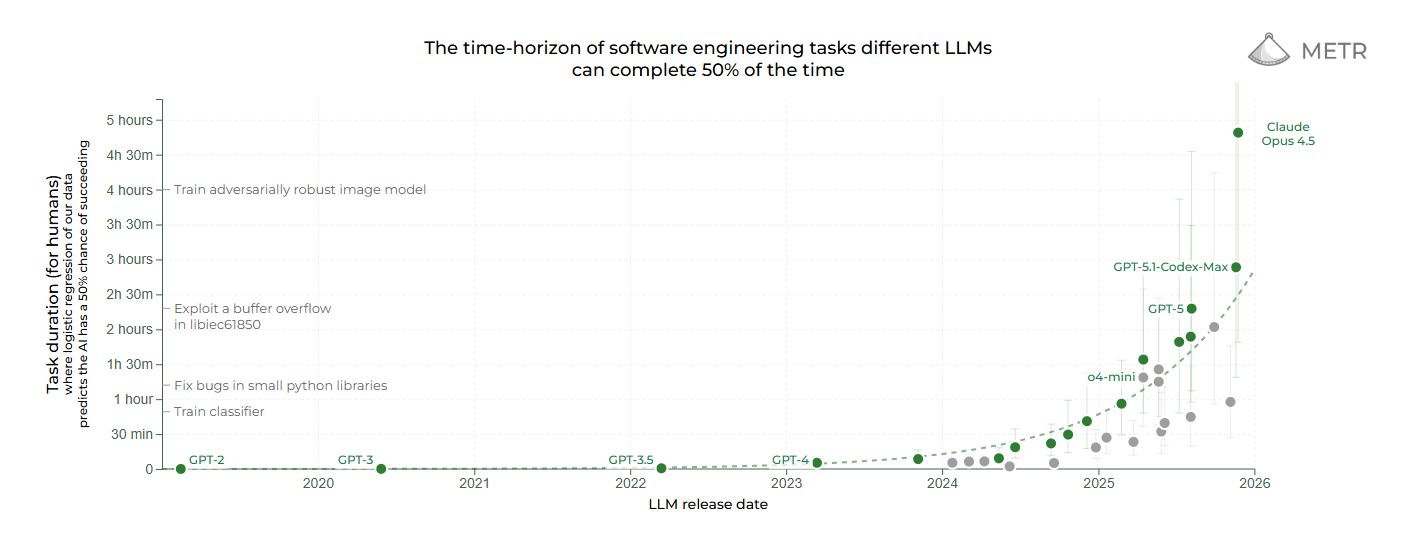
According to the data:
2026: An AI will be able to complete tasks that take a human 3 hours.
2028: It will autonomously handle tasks requiring 8 days of human work.
2032: At this rate, a single AI task could equal 1,212 years of human work.
It sounds like science fiction, but when I look at how my own workflow has changed in just the last 12 months, these numbers start to feel conservative. We are heading toward a world of “cognitive hyper-abundance,” where the limit is no longer the ability to execute, but the imagination to ask.
🛠 Reality Check: The Technical Viewpoint
Before we get lost in the hype, we need to stay grounded. As a technician, I see new problems on the horizon that the “gurus” won’t tell you about:
Code Bloat: AI tends to be verbose. If you aren’t an experienced architect who knows what to cut, you will end up with massive, unmaintainable software.
The Debugging Paradox: Debugging code written by an “alien” logic (AI) is often harder than debugging human code. The error isn’t in the syntax, but in the “intent.”
Security: Agents that execute code autonomously are powerful, but frighteningly risky if not properly sandboxed.
Conclusion
2025 has taught us that AI is not magic; it is high-speed engineering. We won’t stop working, but we will stop being “bricklayers of bits.” We will all become architects. The question is: are you ready to put down the trowel and start drawing the blueprints?
Incredible