
The AI Isn't Broken. Your Mental Model Is.
4 complaints, 1 root cause, and the gap between wasting time and earning 56% more.

TL;DR:
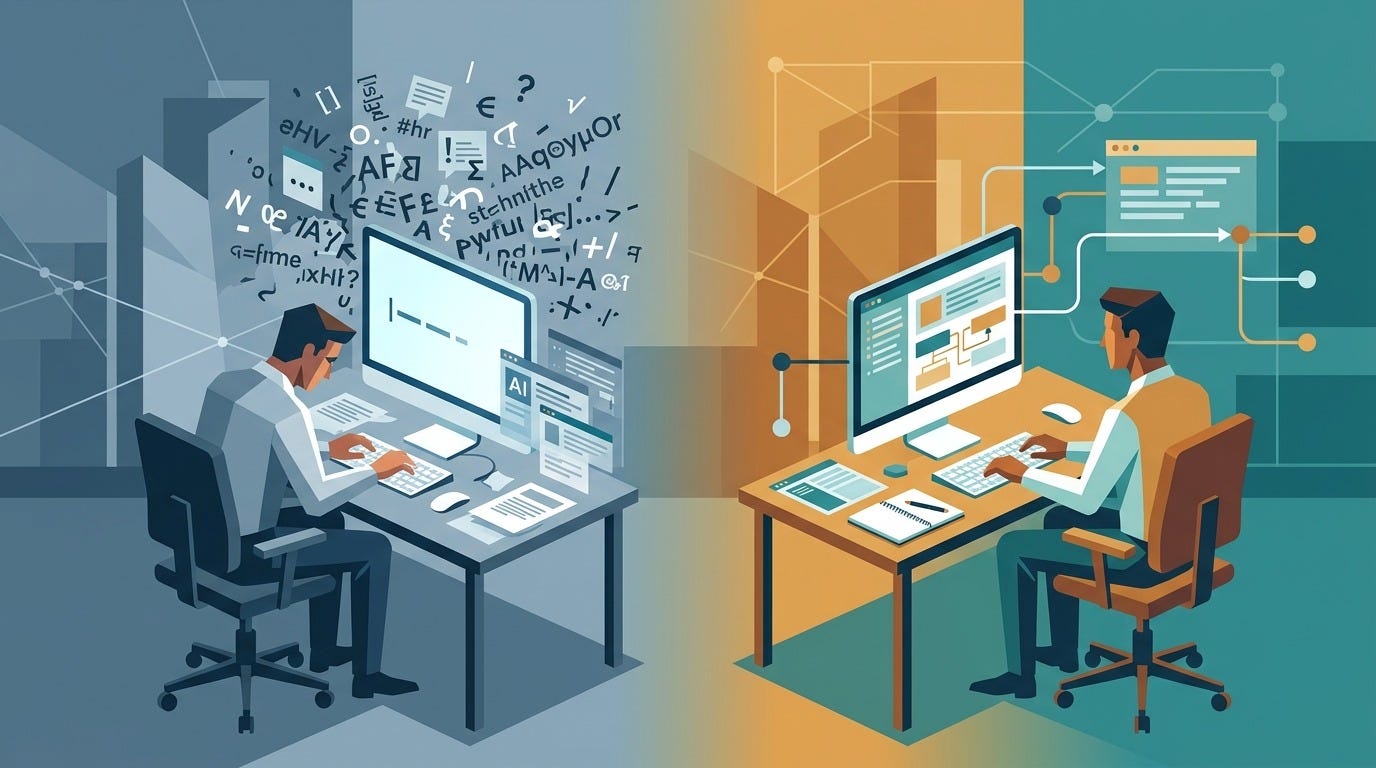
44% of workers say AI does more harm than good at their company. 40% of time saved gets lost to rework. The frustration is real, documented, and widespread. But the common diagnosis, “AI doesn’t work,” is wrong.
The frustrations cluster into 4 precise patterns, all sharing the same root cause: a broken mental model of what AI is and how it should be used.
The 5% who use AI strategically earn up to 56% more. They don’t use different tools. They use the same tools differently.
Let’s start with the numbers, because numbers don’t have opinions.
44% of workers surveyed in 2026 by Metaintro believe AI does more harm than good at their company. Not “have concerns.” Not “are skeptical.” They believe it actively causes more damage than benefit. 40% of time saved through AI gets subsequently spent correcting AI output (CIO survey, 2025). 25% of professionals say, flatly, that AI saves them no time at all. And 47% report that their workload has increased since AI adoption, not decreased (Metaintro, 2026).
If these were numbers for any other enterprise tool, we’d have shelved it already. But AI isn’t any other tool. It’s the tool the world is betting trillions on. So the question worth asking isn’t “does AI work?”, because it does. The question is: why isn’t it working for nearly half the people using it?
The answer isn’t “AI isn’t ready yet.” The 2026 models are extraordinarily capable. The answer isn’t “we need better tools.” The tools are here. The answer is more uncomfortable than either: the majority of people are using AI with the wrong mental model.
I spent months collecting data, surveys, real complaints from professionals and managers. And I noticed something: the frustrations aren’t random noise. They aren’t scattered opinions from disgruntled workers. They cluster into four precise patterns. And all four point to the same root cause.
When I built the course, I went looking for the most common complaints about AI. I found exactly these four patterns. Every module I wrote answers one of them. What follows is the condensed version.
“AI gives me generic answers. It doesn’t understand what I want.”
The first pattern is the most widespread, and the most frustrating because it seems to confirm the suspicion that AI is fundamentally overhyped.
The numbers: 30% of AI-produced content is irrelevant or repetitive. 65% of complaints about AI tools concern inaccurate or useless responses. The feeling many describe goes like this: “I asked it to write an email and it gave me something I could have written myself in three minutes, only worse.”
The problem isn’t AI. The problem is that most people use it like a search engine: short query, expectation of a perfect answer. But a search engine retrieves information that already exists somewhere. AI does something fundamentally different: it generates new text based on the context you provide. And here’s the critical point. If the context you provide is “write an email,” the AI has nothing to work with. It fills the gaps with the statistical average of its training data. Which is, by definition, generic.
It’s like walking into a restaurant and telling the waiter “bring me some food.” Technically, they’ll bring you food. But the odds of it being exactly what you wanted are slim.
The practical answer is simpler than it sounds. An effective prompt has four components: context (who you are, what’s the situation), role (what you’re asking the AI to be), objective (what it should produce exactly), format (how the response should be structured). This isn’t a magic formula. It’s the same logic you’d use when briefing a new hire: the more information you give them about the situation, the better the output. Nobody would be surprised if a new employee, told only “write an email,” produced something generic. Yet we’re surprised when AI does exactly the same thing.
The difference between mediocre and excellent AI results rarely comes down to the tool. It comes down to the quality of the question.
“AI makes things up. I don’t trust it.”
The second pattern is more insidious because it strikes at trust. And trust, once broken, is hard to rebuild.
Here are the numbers: intensive AI users encounter 3 times more hallucinations than occasional users (Rev study). Only 17% of users have never had to rewrite a prompt to correct false information. Translation: 83% of people using AI have dealt with fabricated facts presented as truth at least once. Not nuance errors. Fabricated facts.
The cause is structural, not accidental. People treat AI like Google: a system designed to retrieve verified facts from existing sources. But AI doesn’t retrieve facts. It generates statistically probable text given the context. These are two fundamentally different operations, and confusing them is the single error that produces the most disappointment. Hallucinations aren’t a bug to be patched in the next release. They’re a structural feature of how the technology works. Those who understand this use AI as a brilliant collaborator to be verified. Those who don’t understand it trust blindly and then feel betrayed.
This also explains an apparently counterintuitive data point: why heavier AI users encounter more hallucinations. It’s not that AI performs worse for advanced users. It’s that advanced users ask it more things, across more topics, and inevitably hit the tool’s structural limits more often. Light users stick to simple tasks with small margins of error. Heavy users push to the edges, where the edges become visible.
The practical rule: never use an AI output for anything consequential without verifying critical data against a primary source. This isn’t distrust of the tool. It’s the same logic you’d apply to a brilliant colleague who tends to be optimistic about details. AI is excellent for structuring ideas, synthesizing documents, generating options, exploring new angles. It’s unreliable for citing exact numbers, names, or specific dates without an explicit source in the context. Knowing where the excellence ends and the unreliability begins is the difference between using AI and being used by it.
Yet understanding hallucinations is only half the story. Because even those who learn to manage them often face an even more practical problem.
“It costs me more time than it saves.”
This is the pattern that hurts the most, because it strikes directly at AI’s core promise: productivity.
The numbers are brutal. 40% of time saved by AI is lost to rework (CIO survey, 2025). 47% of workers report increased workload after AI adoption (Metaintro, 2026). 25% say AI saves them no time whatsoever. And there’s a new phenomenon researchers have started calling “AI brain fry”: when people use 4 or more AI tools simultaneously, self-reported productivity collapses. 34% of those experiencing this overload are actively planning to leave their company (BCG study, Fortune 2026). Not switch tools. Leave the company.
The root cause is twofold. First problem: ad hoc use without a system. People add AI as a layer on top of their existing workflow instead of redesigning the workflow itself. Result: they have AI everywhere, but no process has actually changed. It’s like adding a second engine to a car without modifying the transmission. You go faster for thirty seconds, then everything seizes up. Second problem: using the wrong tool for the wrong task. Using ChatGPT for everything is like using a hammer for everything. Sooner or later you need to drive a screw, and the hammer doesn’t work. Different models have different strengths, and ignoring this is a reliable way to waste time.
The real productivity gain doesn’t come from occasional AI use. It comes from systematic integration into specific workflows. The right starting point isn’t “where can I use AI?” but “which activities in my day are repetitive, predictable, and require more time than judgment?”. Those are the candidates. Activities that require contextual judgment, human relationships, or final accountability stay human. The most common mistake is starting from the tool and looking for a problem to solve with it. The method that works is the opposite: start from the problem and find the right tool.
The 5% who truly use AI earn 56% more. They don’t use a different AI. They use it differently.
This brings us to the final pattern, the one that holds all the others together. Because the gap between the 5% who succeed and the remaining 95% who struggle isn’t a gap of talent or tools. It’s a gap of method. And in most organizations, that gap isn’t being closed.
“I don’t know how to bring it into my work or my team.”
This is the systemic pattern, the one that explains why the previous three keep repeating in a cycle.
The data tells a clear story. 63% of workers haven’t received adequate AI training (Metaintro, 2026). Of those who have, 41% describe it as “too generic, one-off, useless” (Metaintro, 2026). But the most revealing number might be this one: 88% of executives say they’re satisfied with AI tools, versus only 21% of workers (CEOWORLD survey, 2026). That’s an enormous perception gap. The people who approve the purchase are satisfied. The people who use the tool every day aren’t. And neither side understands the other’s perspective.
The cause is simple and painful: adoption happens at the tool level without changing processes. Companies buy the enterprise license, send an email with the access link, and expect something to happen. Nothing happens. Nothing happens because the tool hasn’t been assigned a specific problem to solve. It’s like buying an industrial machine, placing it in the middle of the factory floor, and waiting for employees to figure out what it does on their own. Training, when it exists, is a one-hour generic session. The 44% who say AI does more harm than good aren’t wrong about the frustration. They’re wrong about the diagnosis: the problem isn’t the tool, it’s the absence of a method for using it.
AI’s return on investment in a business setting isn’t found where everyone looks, which is total automation of complex processes. It’s found in high-impact, low-complexity use cases: research and synthesis of long documents, first drafts of recurring communications, exploratory analysis of existing data, structured meeting preparation. Identifying three of these in your specific context and building a repeatable process is worth more than any generic training session.
The real problem is that most organizations are trying to make a ten-meter leap when they haven’t learned to walk yet. Simple use cases aren’t sexy. They don’t make it into board presentations. But they’re the ones that work, that build trust in the tool, and that lay the groundwork for more ambitious applications.
Reality Check: None of these four problems is AI’s fault. They’re all a consequence of how AI has been sold: as a tool that works on its own, without effort, without context, without method. It doesn’t work that way. It has never worked that way. No powerful tool in the history of technology has ever worked that way. Excel didn’t automatically make you a financial analyst. Photoshop didn’t make you a designer. Your CRM didn’t make your sales team more effective until someone decided how to use it. AI won’t automatically make you more productive. It will make you more productive if you learn to use it. And learning to use it means, first and foremost, abandoning the broken mental model and building one that works.
Recognized one of these four patterns in how you work with AI? The course was built to answer each of them systematically: from foundations (what AI actually does under the hood) to prompt engineering, tool selection, workflow integration, and team adoption. 200+ pages, 8 modules, practical exercises you can complete in 30 minutes with free tools. Until April 30 the price is €47 (then €67). The PDF is yours permanently. Full details here.
AI isn’t the thing that’s letting you down. The gap between expectation and method is.
If you expect perfect answers from a vague question, you’ll be disappointed. If you expect the tool to work on its own, you’ll be disappointed. If you expect buying the license to transform your company, you’ll be disappointed.
But those who close that gap don’t use a better AI. They use the exact same AI in a completely different way. And that 56% earnings premium for the top 5% of users isn’t an abstract number. It’s the exact measure of what that gap is worth.
The right question isn’t “does AI work?” The right question is: am I working with AI the way it’s meant to be worked with, or am I fighting a tool I never actually understood?
If this article put into words something you’ve been feeling but couldn’t quite name, a restack puts it in front of someone who’s losing hours wrestling with AI without knowing why.
That satisfaction gap between executives and workers reads like the same mental model problem, one level up. Executives aren’t using the tool every day so they might miss the hallucinations, the rework, the false confidence. Workers see it.
I agree we can all learn to use AI tools better, and I think there’s also a real risk of overconfidence as our knowledge increases. Confirmation bias is real and also extremely enticing.
AI literacy isn’t just about strong prompting and understanding the tools better. It’s knowing how to verify and ratify what we’re being told, especially when the information we receive sounds polished and convincing.